


One of the biggest mistakes we can make as business owners is spending months building something before checking if people will actually buy the thing we’re creating. I’ve done it myself too (quite a few times!). It’s tempting to wait until something feels just right before we put it out into the world, but that can slow down momentum and increase pressure for it to be perfect.
I recently learnt about ‘low fidelity testing’ through an IDEO U course I completed and it’s something that I keep coming back to as a helpful reminder when I get too tied up in new things needing to be perfect.
It often feels most comfortable to perfect something, before releasing it ‘fully’. Low fidelity testing teaches us that doing the opposite of this is more likely to keep ideas moving and momentum going.
Low fidelity testing is putting together an experiment and testing to get feedback and develop ideas. This could be trialling a new product, a new service, a new website or even pricing and prototyping social media ads. The most important aspect is that it’s the bare bones (aka your minimum viable product (MVP)) that you are testing, not a polished version.
Low fidelity testing gives you feedback before you overcommit and it can be invaluable to you making the right next steps in your business. The most important question you can ask yourself when in this testing phase is “What’s the quickest way I can test whether this has potential?”.
One of the easiest ways to understand low-fidelity testing is to compare it with high-fidelity testing.
Low-fidelity testing is quick, inexpensive, flexible, and focused on gathering feedback. Examples might include:
- a rough mock-up
- a waitlist page
- a test workshop
- a role-play
- a social media poll
- a pilot offer
The idea is that you’re testing the idea before fully building it.
High-fidelity testing is much closer to the finished version and more polished and usually more expensive and time-consuming to create.
Examples could include:
- a fully built website
- professionally manufactured products
- a fully developed app
- a fully produced online course
- a complete launch campaign
High-fidelity testing definitely has its place, but many small businesses jump there from the start with the aim for things to be perfect. It’s easy to spend months building something before checking whether customers actually want it. Low-fidelity testing helps reduce that risk.
Most successful businesses are not built from one single idea. They’re built through iteration. Testing matters because ideas almost always change once they are tested on real people.
What sounds really clear in your head may confuse customers, not be solving the right problem, feel too expensive or too difficult to explain. Without testing, we’re often making decisions based on assumptions rather than evidence. That can lead to wasting time and money on the wrong thing and creating offers nobody really understands.
Low-fidelity testing protects both your finances and your energy and helps you to learn fast so you can best serve customers more easily when you do officially launch.
Some people may avoid low-fidelity testing because unfinished ideas can feel vulnerable. We think we need to have everything figured out before we show people. I understand as I often feel the same too and it’s something I have to remind myself all the time.
A brilliant way around this feeling of vulnerability is to be honest with your audience that you’re testing and ask for feedback. People are often a lot more understanding and actually quite excited to help you shape something from the ground up.
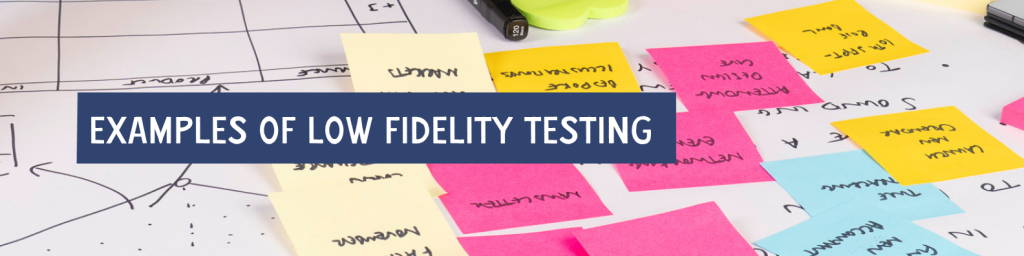
One of my favourite examples local to me was a “Guinea Pig Night” dining concept trialled at the Leeds Corn Exchange. The restaurant there (years ago!) offered a fine dining menu at a significantly reduced price and was clear with customers that they were offering this in return for feedback.
There’s a brilliant example in the book Sprint about Savioke, an American company who wanted to launch a robot to support hotels to deliver things like towels and toothbrushes to guests’ rooms. Rather than immediately investing heavily in advanced robotics, the team first tested the experience itself in a much simpler way. They attached a normal tablet to a very basic robot and recruited volunteers to interact with the robot and feedback afterwards.
The book Creative Confidence also includes great example of a prototype MRI scanner for children. This prototype created the MRI scanner as a pirate ship and they tested how much more comfortable children felt in going in for MRI scans. Patient satisfaction went up to 90% and the idea was rolled out across many other hospitals.
1. Launch version one
Instead of waiting for something to feel perfect, ask yourself “What’s the simplest version I could test?”. That could mean running a live workshop before recording a course, or trialling a pilot offer before fully scaling it.
2. Build and test before you invest
Before investing in expensive systems to automate things, test the experience manually first. You’ll often learn what actually matters before spending money building the systems around it.
There’s a brilliant example from Skip, an Australian company, who wanted to launch a food collection and delivery app. Before they built the app, they tested the whole process with people texting their orders and payments in and a person messaged them back and managed it all behind the scenes (as if they were an app). This meant the customer could get enough of an experience to give feedback, before Skip invested any money and time in the app.
3. Ask for feedback
Ask for feedback in an anonymous way to encourage people to open up about what they think. I’m a big fan of an anonymous Google Form! Questions like ‘what would your barriers to buying be?’ can be really eye opening!
It can also be great to test with your audience on Instagram – polls on stories can be a great tool for this.
4. Build in public
One of the most effective forms of low-fidelity testing is letting people see ideas evolve in real time and let people know that you’re building something new.
That could look like:
- sharing behind-the-scenes thinking
- talking about experiments openly
- showing rough concepts
- inviting people onto waitlists early to be part of your guinea pig group.
Building in public helps you understand what people like and don’t like before fully committing to an idea, whilst also helping people feel invested in your business idea.
5. Treat your business like an experiment
Some of the best ideas emerge through testing, adapting and refining over time. I’ve recently been in the cycle of not launching something new, but last week I decided to experiment with something new, just to have a bit of fun!
I launched Creative Field Trip, a new creative networking event. It feels a little removed from my strategy work, but I also reminded myself that it’s important to have fun! I’ve had a million ideas about Creative Field Trip as its own brand and different trips we can do (Creative Field Trip Barcelona, anyone?). But before I invest any more time into thinking about it I’ve booked the first event in the diary to get feedback. That will allow me to learn what resonates, what people are excited by and what I’ll change next time, without the pressure of needing to have it all figured out from day one.
I also have to remind myself that when I first launched Super Seconds Festival that it launched as just a hashtag (#supersecondssaturday) and it was free to join – and 6 years on, there are 250 makers all paying around £45 each to be involved and I have a team who work on it with me!
If you remember one thing from this, I’d love it to be that the key is to stay curious and be open with your audience that you’re building something new. This can lead to incredibly helpful feedback that helps you to grow and develop the best possible offers for your audience.
Do you do any low fidelity testing in your business? I’d love to hear about your examples in the comments!
